
Have you ever wondered why the large yellow lifting equipment shown above was called a crane? While the term "crane" often refers to a bird which known for its long neck, but now it also names this essential handling equipment.
The term “crane” for this lifting equipment was originated from Ancient Greeks. The features of this equipment which having tall vertical column and an angled, rotating boom, resembles the bird's long neck and beak, leading to it to be named as crane.
Historically, cranes marked a significant technological advancement, largely replacing simple ramps for vertical transport. The ancient Greeks invented these advanced lifting devices using ropes, pulleys, and wooden beams powered by human or animal labour. These innovations enabled the construction of monumental structures like the Parthenon, showcasing Greeks’ engineering ingenuity.
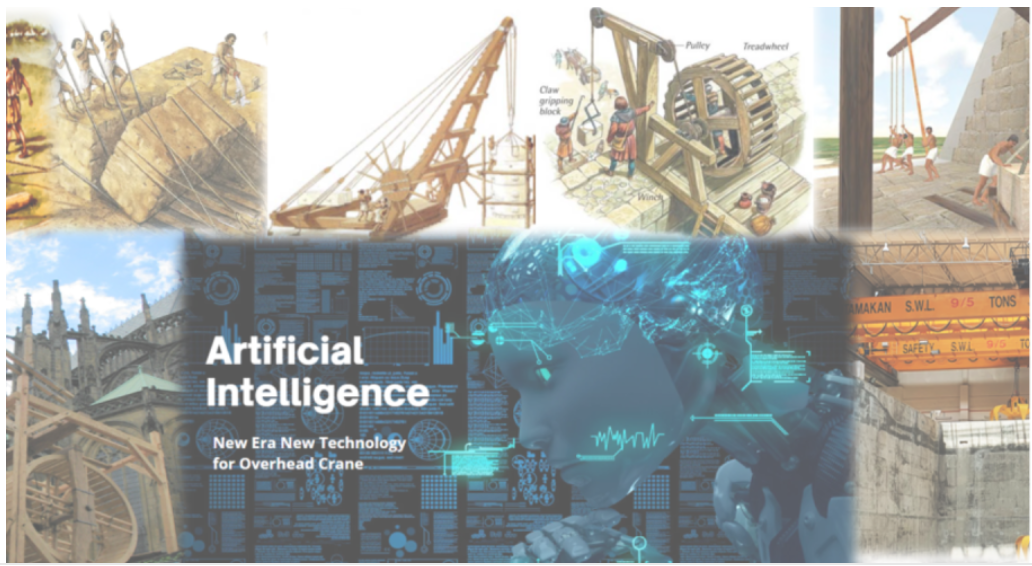
Cranes have played a crucial role in building our world's infrastructure from ancient times to the present, transforming how heavy loads are lifted and transported vertically. Now, let's take a deep dive into the evolution of the overhead crane.
Ancient Civilizations (Before Centuries BC)
5000 BC:
Early civilizations like the Egyptians and Mesopotamians ingeniously employed basic lifting devices, such as levers and sledges, to transport massive stones and other heavy materials. These simple yet effective tools enabled them to construct monumental structures, demonstrating their understanding of simple physics and engineering principles.
3000 BC:
The construction of the Great Pyramids involved advanced techniques for their time, including the use of inclined planes to transport large stones up ramps. There is also some evidence revealing that the Egyptians might have utilized the so-called primitive cranes and pulley systems to lift these large heavy blocks for the construction of Great Pyramids.
1st Millennium BC
500 BC:
Ancient Greeks pioneered the development of more advanced lifting devices, leading to the creation of the earliest known cranes. These cranes utilized simple rope systems, pulleys, and wooden beams, powered by human or animal labor. They significantly enhanced construction capabilities, enabling the lifting of heavy loads for monumental projects such as the Parthenon. This innovation marked a significant leap in their construction, showcasing Greek ingenuity in overcoming architectural challenges and laying the groundwork for future advancements in crane technology.
1st Millennium AD
50 AD:
Though the crane was invented in Greece by Ancient Greeks but it was perfected by Romans. Romans made significant improvement on Greek crane technology, by incorporating treadwheels (operated by a person walking inside a large wheel) which significantly improved the equipment’s performance capacity, to achieve greater lifting heights and even handling heavier loads. Roman cranes are used extensively in constructing aqueducts, amphitheaters, and other large structures.
500-1500 AD:
During the Middle Ages, cranes evolved notably in Europe. Although the treadwheels remained as common part in crane, but innovations such as counterweights and gearing systems emerged. Cranes became essential equipment in Europe’s construction, particularly for building castles and cathedrals, as they allowed for lifting heavy stones to greater heights.
16th to 19th Century
16th Century:
The Renaissance saw a renewed interest in engineering and mechanics. Leonardo da Vinci sketched innovative designs for overhead cranes and lifting devices, demonstrating a deep understanding of mechanical principles. His designs included advanced gear systems and counterweights, showcasing his vision for improved efficiency and functionality. This period also saw the construction of more sophisticated infrastructure, such as bridges and domes, requiring advanced lifting technology. Renaissance engineers studied ancient Roman texts, integrating classical knowledge with contemporary advancements. Workshops and universities became centres of innovation, fostering the development of new overhead crane technologies and enhancing the construction capabilities of this era.
18th & 19th Century:
The Industrial Revolution begins, it marked a transformative period in the history of overhead cranes. With the advent of steam power and later electric motors, cranes evolved into more powerful and versatile machines. The introduction of steel as a construction material facilitated the creation of robust crane structures capable of handling significant heavy loads especially when entering to 19th century. Following are the transformative milestones achieved in the 19th Century:
- 1830: The first steam-powered overhead cranes are developed, significantly enhancing lifting capabilities in shipyards and manufacturing.
- 1830: The first crane company in Germany, Ludwig Stuckenholz, was established which later became Demag Cranes.
- 1840: Mass production of overhead cranes begins in Germany.
- 1854: Sampson Moore & Co. in Liverpool, England, patents a new winch mechanism, allowing the lifting of heavier weights (such as Royal Guns Factory) by an electric motor.
- 1861: The first steam-powered overhead crane is installed by John Ramsbottom at the Crewe Railway workshops. Power is transmitted to the crane from a pulley driven by a stationary engine through an endless cotton rope.
- 1874: Thomas Rees Morgan from the USA patents the first steam-powered overhead traveling crane.
- 1887: The Ludwig Stuckenholz company introduces electrical components to overhead cranes, setting a new standard for industry design.
20th Century
Early 1900s:
The introduction of electric motors revolutionizes overhead crane technology. Electric overhead cranes become common in factories, steel mills, and other industrial settings.
- 1910: The first mass-produced electric motor hoist starts in Germany.
- 1914 : Electrically operated crane by a control pendant and from an operator cabin attached to the crane.
- 1930s-1940s:
World War II drove significant advancements in overhead crane technology, emphasizing increased lifting capacities and enhanced reliability to meet armed forces production demands. Innovations included stronger materials, improved hydraulic systems, and greater mobility. These improvements enabled the efficient construction of military infrastructure, shipbuilding, and the handling of heavy machinery and supplies.
- 1950s-1960s:
The post-war boom led to widespread adoption of overhead cranes across various industries. Innovations included remote controls, which enhanced precision and efficiency, and improved safety features such as emergency stop systems and load simple sensors. These advancements facilitated mass production, streamlined material handling, and boosted overall industrial productivity.
1980s:
Computer technology integration into overhead crane operations allowed for more precise control, simple automation, and enhanced safety measures. Designers and engineers started to explore the new features in overhead crane such as load monitoring and automated positioning. Such technological advancement increased operational efficiency, reduced human error, and improved overall safety in lifting and material handling processes.
21st Century
- 2000s:
Continued innovations in overhead crane technology focus on energy efficiency and sustainability. Regenerative drives, which capture and reuse energy, and other energy-saving technologies are integrated into crane systems. These advancements not only reduce operational costs but also minimize environmental impact, aligning industrial practices with eco-friendly standards.
- 2010s:
The digital revolution has advanced overhead crane technology with sensors, IoT connectivity, and advanced software, enabling real-time monitoring and predictive maintenance. These smart overhead cranes enhance efficiency, safety, and reliability. The COVID-19 pandemic accelerated the adoption of smart overhead cranes, the implementation of social distancing and lockdowns required industries to maintain productivity with fewer on-site workers. Smart overhead cranes met this challenge by using IoT and remote monitoring to enable efficient, safe, and continuous operations. This adaptation ensured operational continuity during the pandemic and accelerated the adoption of smart overhead crane technologies across various sectors.
- 2020s:
The rise of artificial intelligence (AI) and machine learning further enhances overhead crane operations. AI-powered overhead cranes can optimize lifting processes, improve safety, and adapt autonomously to complex environments. They also enable predictive maintenance, reducing downtime and extending equipment lifespan. These advancements increase efficiency, precision, and reliability in construction, transforming traditional overhead crane into intelligent operations, responsive systems capable of handling modern-day challenges. This integration of AI ensures that overhead cranes operate at peak performance while minimizing risks and operational costs.
Future Prospects:
Overhead cranes will continue to evolve with advancements in robotics, renewable energy integration, and smart infrastructure. The focus is on creating more efficient, sustainable, and intelligent lifting solutions to meet the demands of modern industry and construction. Robotics will enhance automation, allowing overhead cranes to perform complex tasks with minimal human intervention, increasing precision and safety. The integration of renewable energy sources, such as solar will make overhead crane operations more sustainable, reducing carbon footprints and operational costs. Smart infrastructure will enable overhead cranes to communicate with other machinery and construction site systems, optimizing workflow and improving project management through real-time data analysis.
These innovations will lead to cranes that are not only more capable but also environmentally friendly and economically efficient. As industries strive for greater sustainability and efficiency, the continuous improvement of overhead cranes will play a pivotal role in meeting these evolving needs, ensuring they remain integral to infrastructure development and industrial operations.
Conclusion.
The evolution of cranes, from ancient lifting devices to today's advanced AI-powered machines, highlights significant technological progress in industrial operations and infrastructure development. Named for their resemblance to the bird, cranes have evolved from simple levers and pulleys used by Egyptians and Greeks to more complex systems powered by steam, electricity, and now AI. Overall, the continuous evolution of crane technology reflects an ongoing commitment in improving efficiency, safety, and capability in industrial sectors, ensuring overhead cranes remain crucial in the future